Technology Explained
What Farm Cameras See at Night: Infrared vs Full-Color Night Vision
Black-and-white IR or full-color? Night vision is about light, not megapixels. What farm cameras actually see after dark — and how to choose per spot.
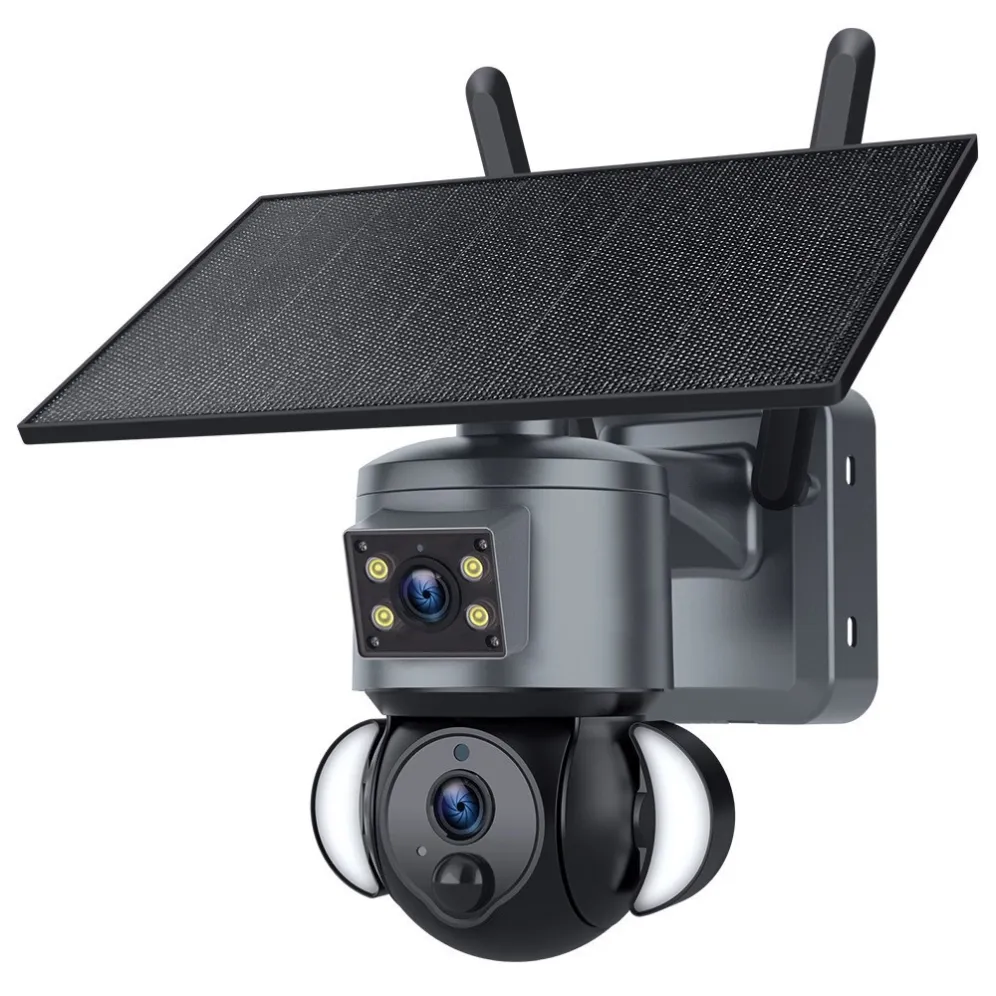
The first question farm buyers ask is usually the night one: "What will I actually see after dark?" The honest answer is that it depends on three things — how the camera adds light, whether it wakes up on events, and what lens and sensor it pairs that light with. Night vision is a light problem, not a megapixel problem. A camera with fewer pixels and a strong infrared or white-light source will show you more at midnight than a higher-resolution camera that has nothing to illuminate. This guide explains the two night-vision approaches on solar security cameras — infrared (black-and-white) and full-color (with white light) — and how to choose per spot instead of per spec sheet.Honest note up front: we are not going to quote an infrared distance for you, because the real answer depends on the sensor, the LED array, the lens angle and the mounting height — it varies by unit and by spot. What we will give you is the framework to read any spec sheet correctly, ask the right questions, and pick the right night behavior for each place on your farm.
Who this guide is for
- Farm and ranch owners deciding between infrared and color models for gates, barns, pens and yards.
- Dealers and brand owners who need to explain night vision to end customers without over-promising.
- Buyers comparing spec sheets who want to know why two "night vision" cameras look so different.
Why "more megapixels" does not fix the dark
Here is the physics: at night there is almost no light for the sensor to record. Resolution tells you how many pixels exist; it says nothing about how many photons reach them. A camera facing a pitch-black paddock records "pitch black" in 4K just as faithfully as in 1080p.What changes the image at night is active light — infrared LEDs (invisible to humans and animals, recorded as black-and-white) or white LEDs (visible, recorded in color) — plus a sensitive sensor and a lens that gathers enough light. That is why night-vision quality lives on the LED board and the sensor, not on the resolution number in the title. When a vendor leads with pixels for a night camera, ask what lights it carries instead.There is a second factor that matters more than either: event triggering. The best night image in the world is useless if you are not looking at it. Solar cameras run on event mode — a PIR or radar trigger records a short clip and pushes it to your phone. At night, your phone becomes the night watchman: you are woken by notifications, not by standing at the window. Event mode is what makes night monitoring practical on a battery budget.
The two ways cameras see in the dark
Infrared (IR) night vision — black-and-white
- How it works: invisible infrared LEDs illuminate the scene; the sensor records it as black-and-white video.
- What it is good for: it does not alert people or animals that they are being watched — a key advantage for predator monitoring and for discreet surveillance of lanes, gates and remote paddocks. It draws less power than white light, which matters on a solar unit in winter.
- What to expect: you see shapes, movement and clear silhouettes, not coat color or license-plate-level detail at distance. For "is something moving there" and "who is at the gate after dark," infrared does the job.
Full-color night vision — with white light
- How it works: white LEDs come on (automatically on low light, or when an event fires) and the sensor records color video.
- What it is good for: color tells you far more in an instant — animal markings, vehicle color, clothing, what is actually in the pen. For calving pens, barn doors and the yard where you want to identify rather than just detect, color is the better evidence.
- What to expect: the lights are visible — animals and people can see they are on camera (often exactly what you want as a deterrent). The extra light costs more power, so on solar units full-color should be paired with event mode and, in winter, with a power budget you have actually planned.
Dual-mode cameras — both when you need them
Many solar cameras let you switch night behavior per spot: infrared as the default (discreet, power-efficient), white-light color triggered by an event, or always-color where the spot demands it. The right question is not "which technology is better" but "what does this spot need at night" — the answer changes by location, not by price tier.
"See clearly" vs "see that something moved": pick per spot
Split your farm into two night needs before you compare cameras:Spots where you must SEE clearly (identify, not just detect):
- Calving pens and lambing shelters — you need to judge the animal's state from the phone before deciding to walk over.
- Barn doors, equipment doors, main yard — you need color or strong near-range IR to identify a person or vehicle.
- Feed areas where you check feed level and animal condition at night.
Spots where you only need to KNOW something moved (detect, then check):
- Long fence lines and far paddock gates — infrared plus an event notification is enough; you walk or check the clip when triggered.
- Blind corners and approaches — you want the alert and a clear silhouette, not a full-color portrait.
- Pasture perimeters — detection, timestamp and a clip are the deliverable.
Rule of thumb: the closer and more decision-critical the spot, the more it earns full-color or high-quality near-range IR; the further and simpler the spot, the more it earns infrared plus event mode. Matching the night behavior to the spot is what makes a farm camera system feel "right" — and it is how you avoid paying for color you do not need on a fence line, or being left with black-and-white where you needed to identify a vehicle.
What the spec sheet actually tells you
Read night-vision specs in this order:
- Light source: how many infrared or white LEDs, and what type. This is the first number to compare.
- Night-vision mode: fixed IR, full-color with lights, or switchable dual-mode.
- Sensor and lens: larger sensor and a lens that opens wider gather more light; lens angle trades width against how far you can identify detail.
- Trigger type and range: PIR, radar or both — and the range figure, which is a spec you can verify, not a promise.
- Power behavior at night: what event mode does to the battery through the night — this decides whether a solar camera survives winter.
Any vendor that cannot tell you these five things for their camera cannot honestly tell you what it sees at night. That standard applies to us too: confirm the trigger range and night-vision range from the spec sheet of the exact unit you are quoted, not from a marketing line.
Common misunderstandings
- "Black-and-white means cheap." No — IR is a deliberate choice for discreet, low-power night monitoring; many premium units default to IR.
- "Full-color is always better." It is better at identifying, but it lights up visibly and draws more power. For a remote paddock, that is a cost, not a benefit.
- "The night range number is the whole story." Range figures assume conditions; snow, fog, heat shimmer and mounting height all change the real view. Treat them as a starting point, verify at your spot.
- "More pixels fix the dark." They record darkness in more detail. Light is what changes the picture.
- "A camera sees what you want it to see." It sees what the light and angle allow. Aim for the spot's decision need — detect or identify — not for a generic "good night camera."
Choosing the night behavior: a per-spot table
Farm spot | Night need | Recommended night mode | Why |
Calving pen / lambing shelter | Identify animal state | Full-color (event-triggered) or strong near-range IR | You judge from the phone before walking over |
Barn door / equipment door | Identify person/vehicle | Full-color with white light | Color evidence for a real incident |
Main yard | Deter + identify | Full-color, always-on or event-triggered | Visible lights add deterrence |
Gate / lane approach | Detect + silhouette | Infrared + event push | Discreet, low power, enough to decide |
Long fence line / far paddock | Detect movement | Infrared + event mode (4G where WiFi does not reach) | Cover distance, not portrait detail |
Water point / feed area | Check level & condition | Infrared or dual-mode, fixed aim | Routine glance, no surprise needed |
Your mix will usually be mostly infrared with event mode, and color at the decision-critical few — the pens, the doors, the yard.
FAQ
Can a solar camera record color at night? Only where it carries white lights and they are switched on — color needs light. Units with full-color mode do exactly that; on solar, pair it with event mode so the lights are not burning all night.Is black-and-white night vision a downgrade? No. IR is invisible and power-efficient, which is why many serious farm setups run it by default and use color only where identification matters.How far can a security camera see at night? It depends on the sensor, LED array, lens angle and mounting — there is no single answer. Ask for the night-vision and trigger range from the exact unit's spec sheet, then verify at your spot.Does moonlight help? Low-light color cameras can use moonlight and other ambient light up to a point, but a truly dark paddock still needs active light (IR or white). "Color without any light" does not exist.Will the IR light scare animals? Infrared is invisible to humans and most animals, so it does not disturb them — that is a main reason it is used in calving and predator-monitoring spots.Why does my camera go black-and-white at night? That is IR night vision working as designed. If the spot needs color, choose a full-color or dual-mode unit with white lights, and plan the battery for it.Do white lights drain the battery fast? They cost more than IR. With event-triggered lighting and a correctly planned power budget, solar units handle color at the decision-critical spots; continuous color on many cameras all night is where solar struggles — plan accordingly.What should I send the factory to get the right night-vision mix? Your spot list with which points need detect-only vs identify, mounting heights, WiFi/4G per spot, winter climate, and whether discreet (IR) or deterrent (lights) matters more at each — plus your buying role and quantity.
What to send the factory before you order
- Spot list with night need per point: detect-only or identify.
- Mounting heights and angles you plan.
- Connection per spot — WiFi, 4G, or local card.
- Winter climate and power constraints.
- Discreet vs deterrent preference per spot.
- Buying role and quantity — end-user, dealer or brand; destination market for the correct 4G version.
Get a quotation
Send us your spot list and night needs, and we will confirm the infrared/color mix and connection plan that sees what your farm needs at night — detect where detect is enough, identify where it matters:
- Browse the solar and 4G camera categories: www.keencampro.com
- WhatsApp: https://wa.me/8618948579719
- Email: diana@keencampro.com
#KeenCamPro #NightVision #Infrared #ColorNightVision #SolarCamera #FarmSecurity