Oct 22, 2026Buying Guides
Farm Solar Security Cameras: 8 Questions Buyers Ask Before They Buy
What farm buyers really ask about solar power, 4G, night vision, theft-proofing and winter — with honest answers and what to send the factory before you order.
Farm Solar Security Cameras: 8 Questions Buyers Ask Before They Buy
Last updated: October 19, 2026 · KeenCamPro factory teamIf you are comparing solar security cameras for a farm, ranch, barn or pasture, you are probably asking the same questions every buyer asks us before their first order — because a camera that dies in February, or records nothing useful at night, is a wasted investment plus a false sense of safety. This guide walks through the eight most common buying concerns we hear from farmers and small distributors, with honest answers and the exact questions you should send back to any supplier, including us, before you commit.One honest note up front: we are a camera factory, not a magic company. No solar camera can promise to run forever through weeks of blizzard, no camera can "recognize" a specific thief or predator species, and no supplier should promise you a delivery date they cannot keep. What a good farm camera can do — with the right power, connection and placement — is record when it matters, warn you when something moves, and deter most casual theft and predator visits. This guide helps you ask the questions that separate realistic suppliers from oversellers.
Who this guide is for
Three kinds of buyers read this page, and they ask different questions:
Farm and ranch owners — they want eyes on gates, barns, pastures and equipment, and care most about reliability, power and ease of setup.
Dealers and installers — they buy for resale or customer projects, and care about margin, minimum order quantity (MOQ), warranty and technical support.
Brand owners — they plan OEM/ODM production, and care about factory capability, lead time, quality control and customization.
Find the section that fits you. The "what to ask the supplier" lines at the end of each section tell you what to verify with any factory — including ours — before you commit money.
Will solar power really be enough? What happens in winter?
Short answer: yes for most farms, but only if the panel gets sun, the battery is sized to your recording mode, and you do basic winter maintenance. Cold weather is the real test: A production LiFePO4 cell retains about 85% of its 25 °C capacity at 0 °C and about 75% at −20 °C at a 1C discharge rate, with most of the loss recovered once the cell warms up (chemistry-dependent), short winter days charge less, and snow or dirt on the panel cuts output — US Department of Energy guidance advises against manual snow removal, warning that shovels can cause damage and that clearing snow can do more harm than good, and recommends soft tools such as brooms and brushes if removal is attempted at all — tilted panels that shed snow are the better answer.What to ask the supplier: battery capacity and its recording time in motion-only mode; panel wattage; whether the camera has a low-power / motion-light mode below a charge threshold; working temperature range on the datasheet. Expect a realistic answer, not "runs all winter, guaranteed."
What if there is no WiFi at the barn or pasture?
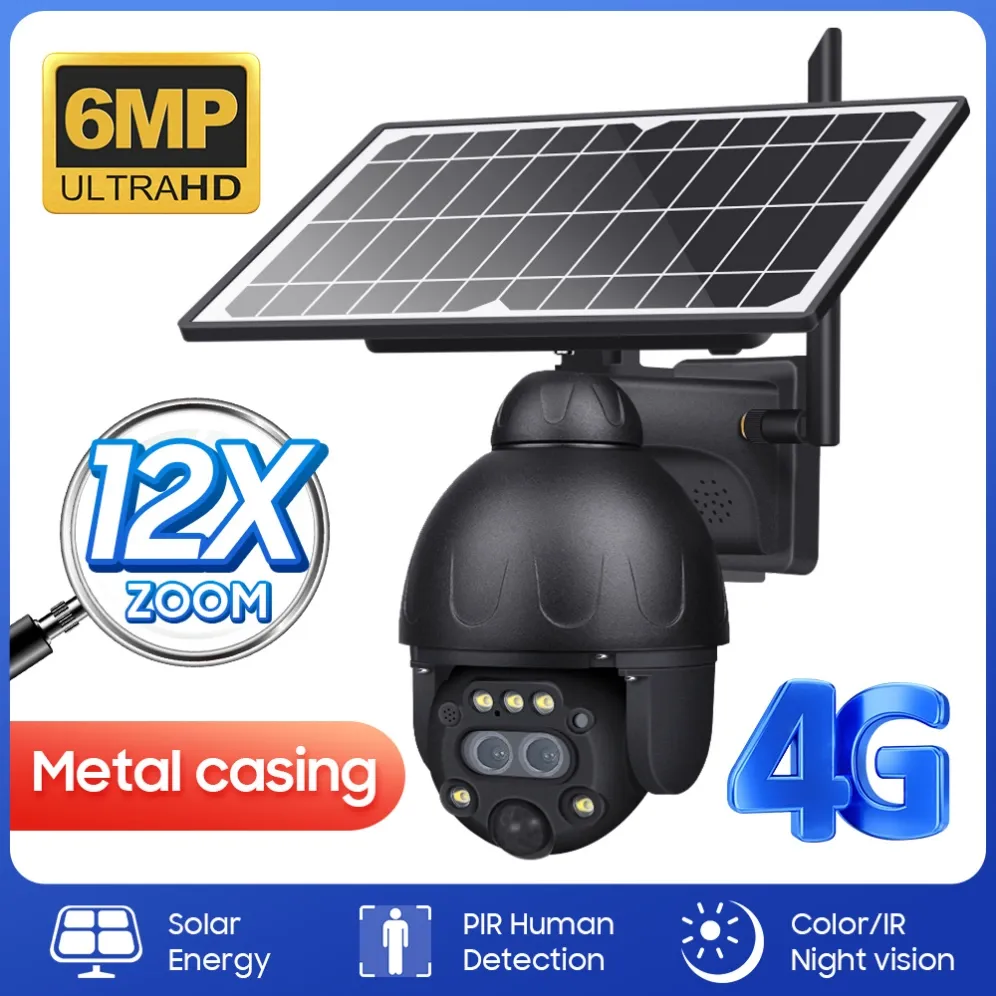
Short answer: choose a 4G (cellular) camera where WiFi cannot reach — this is the single most common reason farms pick solar 4G models. Rural connectivity is still patchy in many markets: the FCC's 2024 Section 706 report found that fixed terrestrial broadband at 100/20 Mbps had not been physically deployed to almost 28% of Americans in rural areas, satellite excluded, with data as of December 2022, and UK rural areas still have 4G dead zones (roughly 3% of England and 17% of Scotland land area, per the House of Lords). Do not assume signal — test it with your phone at the exact mount point before buying.What to ask the supplier: does the 4G model ship a version matched to your region (EU / US / LATAM / APAC)? Which local carriers work? Does it also record to a local card when signal drops? The answer tells you if the camera is built for your market or a generic import.
How far and how wide can it actually see?
Short answer: depends on lens and resolution, not on marketing words like "HD+" or "ultra." A wide-angle lens (around 2.8–4 mm) covers a gate, yard or barn wall well; a narrower or dual-lens setup sees farther down a driveway or fence line. Motion detection range is separate from image range — PIR or radar detection typically covers a shorter distance than the lens can see.What to ask the supplier: lens specs, resolution (main stream), field of view, and detection distance with the exact numbers on the datasheet. Then compare against your actual layout — distances in meters, not "covers the whole farm."
Can it see anything at night?
Short answer: yes, with two technologies — infrared (IR) night vision (black-and-white image) or full-color night vision (LEDs light the scene). Full-color gives better evidence (color, plate readability), IR uses less power and is more discreet. Some cameras let you switch modes or use both.What to ask the supplier: which night modes are supported, whether full-color mode affects battery run time, and how motion alerts are filtered at night — wind-blown vegetation triggers false alerts on basic PIR, while PIR + radar dual detection reduces them. Fewer false alerts = you actually look at the app.
Won't thieves just cut the cable or steal the camera?
Short answer: solar cameras remove the easiest attack — there is no power cable to cut. For the camera itself, look for designs that record to a local card (so footage survives even if the camera is taken), and optional deterrence: motion-activated light or sound that makes a thief move on. No camera physically stops a determined thief; it records, warns and deters — pair it with locks, signage and good placement.What to ask the supplier: local storage capacity and whether it keeps recording without internet; deterrence options (light/sound triggers); mounting options (pole, bracket, fence) and anti-tamper features. Ask for a demo, not adjectives.
Where is my footage stored? Do I pay a subscription?
Short answer: on most farm cameras, video goes to a local TF/SD card in the camera, and you view it remotely through the app (and get motion alerts). Some models support cloud as an extra. The key buying question is whether continuous or event recording fits your card size, and whether the app is free or subscription-based.What to ask the supplier: card size supported, event vs 24/7 recording modes, free app or subscription, and what happens to footage if the camera goes offline (it should keep recording locally). Read the privacy statement — your farm footage is sensitive.
Will it survive real winters (−20 °C, snow, ice)?
Short answer: only if the model's datasheet says so. Look for the working temperature range and weatherproofing (IP rating) in the spec — for example, models rated for −30 °C to +50 °C with IP66 weatherproofing are designed for harsh winters; indoor-only or consumer cameras are not. Cold still reduces battery capacity (see Q1), so winter is a maintenance season, not a set-and-forget season.What to ask the supplier: operating temperature range, IP rating, and how the battery behaves below 0 °C. If the datasheet does not state these numbers, ask why — and check our winter maintenance guide for keeping solar cameras alive in snow.
Should I buy from a factory or a retailer? What about OEM, MOQ and support?
Short answer: it depends on your role. End-users can buy from retailers or a factory; dealers, installers and brand owners usually buy from factories for better pricing, their own brand (OEM/ODM), and direct support. The trade-off is minimum order quantity (MOQ), lead time and payment terms — ask early, not after you have planned a launch date.What to ask the supplier: MOQ and lead time (get it in writing), OEM/ODM capability (your brand on the camera and app), warranty and after-sales policy, spare parts, and who answers technical questions in your time zone. A factory that hesitates on these is a red flag.
Match the setup to your farm type
Buying starts with the right category for each spot, not with a single "best camera":
Farm type | Camera category that fits | Main considerations | Typical setup
Small homestead / backyard farm (up to ~5 ha) | WiFi solar cameras near the house | WiFi reach from the house; simple app setup | 2–3 cameras: house, gate, coop
Mixed livestock farm (10–50 ha) | Mix of WiFi solar and 4G solar at remote points | Power and signal at each spot; PIR+radar cuts false alerts | 4–6 cameras: barn, paddocks, feed storage
Equipment storage / workshop yard | Deterrence models (light+sound) with local recording | Night theft; footage must survive | 2–4 cameras with light/sound triggers
Fully off-grid remote pasture | 4G solar cameras; AOV local-recording as backup | Cellular signal; winter battery discipline | 3–5 cameras with card-based recording
FAQ
How long does a solar farm camera record before the battery drains? It depends on the battery, panel and recording mode — motion-only recording lasts much longer than 24/7. Ask the supplier for run time in your recording mode, and check it with your own app data after the first week.Can a solar camera work without any internet at all? Yes — it can record to the local card, but you lose live viewing and push alerts. For live viewing without WiFi, choose a 4G model with a local SIM.Do I need one camera per gate, or can one cover two areas? Pan/tilt models can sweep a wider area, but they only record what they are pointing at. For two directions you usually need two cameras or a dual-lens model.Are these cameras safe for use around livestock and poultry? The light and sound triggers are the main thing to consider — confirm with the supplier that any deterrent can be set to sensitivity and times that fit your animals; many farms use the same cameras for livestock watch without issues.What happens to my footage if the camera is stolen? If it records to a local card, the card goes with the camera — footage is on the card but may be recovered with the device; cloud backup protects against this at a cost. Ask which applies.Can you help us resell under our own brand? Yes — OEM/ODM with your branding is standard for farm camera factories. Send us your target market and quantity, and we will confirm MOQ, lead time and packaging.Is installation difficult, or do I need a professional? Most solar cameras are DIY: mount on a pole or bracket, aim, pair in the app. The planning is what matters — placement for sun, signal and view, plus SIM setup on 4G models. For a large property, ask the supplier for mounting kits and the installation guide.How should I compare prices — what are the hidden costs? Compare the total kit, not just the camera: panel, battery, mounting hardware, SIM/data (if 4G), memory card, and any subscription. A low camera price with a monthly fee or no bracket can cost more over two years. Ask for a full quotation with lead time and warranty in writing.
What to send the factory before you order
To get a quote that actually fits your farm:
Your layout — spots, distances, whether each has WiFi or 4G signal (phone test result).
Your climate — coldest winter temperature and snowfall.
Recording needs — event-only or 24/7; how long footage must be kept.
Buying role and quantity — end-user, dealer or brand; order size; destination market for the correct 4G version.
Your questions from this guide — the supplier's answers tell you who is serious.
Get a quotation
Tell us your farm type, spots and climate, and we will confirm the camera categories and quantities that fit — no model numbers needed to start the conversation:
Browse the solar camera and 4G camera categories: www.keencampro.com
WhatsApp: https://wa.me/8618948579719
Email: diana@keencampro.com
#KeenCamPro #FarmSecurityCamera #SolarCamera #BuyingGuide #NoWiFiFarm #RuralSecurity